On October 21st 1966, I was 15 days off my eight birthday. I was a pupil at Durham Road Junior School in Newport, South Glamorgan, and my mother had her own salon on Newport Road.
The day, for me, had been like any other, but when I arrived home for lunch, my mother and all her clients were in tears. I don’t remember whether anyone explained to me about the tips engulfing Aberfan’s Pantglas Junior School and the inevitability of death, but I do remember Mum hugging me very hard as the tears fell.
I also remember her emptying a First Aid tin, forcing a ragged cash slot in the lid and sealing with one of the bandages for collections. I can still see that blue and black tin as if it were yesterday.
The 22 miles between Newport and Aberfan were instantly shortened. The victims, the families we had never met, the horror of lives that would never be fulfilled – all entered and stayed embedded in our hearts to this day.
The very words ‘Aberfan Disaster’ still have the ability to induce a silence in which memories are kickstarted again into the present.
Tomorrow sees the 60th anniversary of the disaster in which a community came together, yet also a community torn apart in grief by the coal board that refused to take responsibility for the dangerous slag heaps that loomed their dangerous heads over the valley for years.
For decades, few people could talk about their experiences, and when I recently met some survivors, their elderly faces transformed into youth as they remembered the personalities of the people forever preserved in time.
One, her sister, another her best friend, one her favourite teacher – all three remembering with fondness a neighbour who had been due to go to hospital that morning, but was unable to reach it. His house was buried by the avalanche, killing him.
The 144 deaths, including 116 children, were not confined to the school alone.
I have often travelled up the valleys road from Cardiff, and the dozens of white crosses of Aberfan never fail to move me to tears. How could they not? It was the first time I knew of tragedy and death on a huge scale in an innocent world in which I had experienced only the loss of George my budgerigar – and I hadn’t really experienced that, because Mum softened the blow by telling me the empty cage was because George had flown away to a hot country.
To some extent, we have become immune to death on a huge scale. Twenty-four-hour news, social media, shouting politicians – we live in a world of death by numbers, where every day brings more statistics of mass carnage.
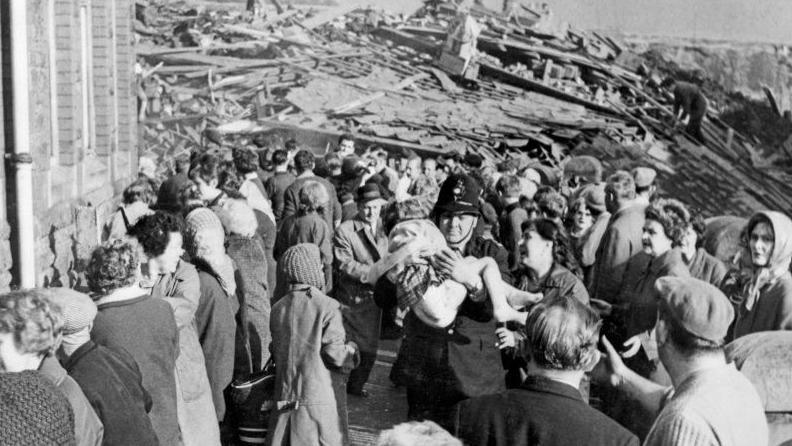
But looking back at 1966 from today’s perspective, it is not just the enormity of the tragedy that is striking, but the sadness of the coverage: black and white footage of desperate people, struggling with their bare hands for day, scrambling for any semblance of life. Miners’ hats, a stretcher, stunned onlookers in their day clothes, having just set off for work – there are so many poignant images from that day and its aftermath: snapshots of the ordinary turned sublimely and horrifically extraordinary.
I have yet to see it, but last night, BBC1 Wales broadcast a widely praised documentary, The Village That Fought Back. Elsewhere, the BBC sidelined it to BBC2, and what did they broadcast in its place on BBC1? A repeat of Death in Paradise. Oh, the irony. Shame on you, BBC. Utter, utter shame on you.
Tomorrow, remember those who lost their lives – yes, the adults, of course, but also a generation of young people, aged seven to eleven, who never got to grow up.
As my 68th birthday approaches on November 5th, I am grateful for the decades I have behind me that were denied them.
Age truly is a privilege.
To read past posts that are exclusive to subscribers, and to gain access to future exclusive content, please consider a subscription to:
https://jacistephen.substack.com/subscribe
Or you can buy me a coffee here (it’s really wine). Click below: