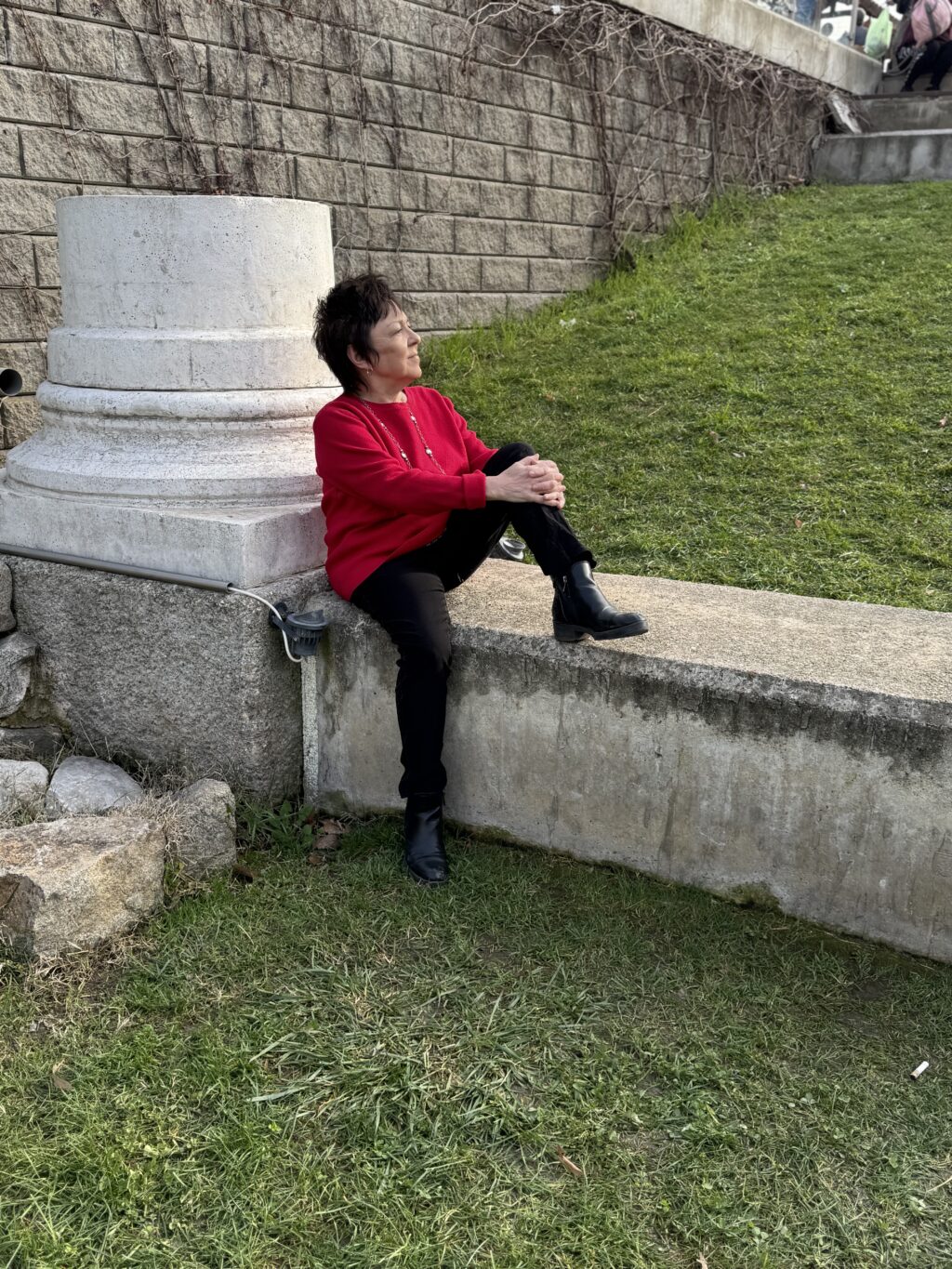
Never lived with anyone. Never been married. No kids. Not gay.
It’s the answer I give every taxi driver when he (it’s always a he) looks in the mirror and asks about my personal circumstances.
It always begins with the marital question, and although the remainder of my answer is unsolicited, I know from experience which way it’s going, so I get it all out in one go to enjoy the remainder of the journey in silence.
Well, usually. Sometimes, an interrogation follows: ‘Why’s that then?’ Oh, dear lord. Just get me to the flamin’ Eurostar.
My aloneness is something I never question until someone starts quizzing me about it. Because I know nothing else, it’s a state of being I long ago accepted and, for the most part, really enjoy. I love my freedom – deciding, at a moment’s notice, to catch a flight or rent an apartment, or, in my case, invariably, both.
‘Not every holiday has to end in a lease’ a friend once told me. To me, it’s not a real holiday unless it does.
This week, though, I’ve been thinking not about aloneness – which is manageable – but loneliness, which is, at best, tolerated, but very hard to manage. When I posted on Facebook ‘We’re not meant to be alone’ yesterday (I was having A Moment), I was overwhelmed and deeply moved by the responses to it, both public and private.
Loneliness is intensified during major holidays like Christmas and Easter and comes in many forms. There were posts and messages from people who have lost a much-loved partner after many happily married years – and others who suffer lonelinesss being in an unhappy marriage.
There were many people in the same position as I am who kindly reached out and offered opportunities to get together, not just in the UK but other parts of the world – many of them people I have never met. The kindness of strangers on Facebook is overwhelming and something for which I feel grateful every day. The site has been a lifesaver for me – often, literally.
So, what is loneliness? The genius writer Rainer Maria Rilke wrote about ‘solitude’, not as a void but a space in which creativity can flourish: ‘It is good to be solitary, because solitary is difficult; and that a thing is difficult must be even more of a reason for us to undertake it.’
He nevertheless acknowledges the enormity of the struggle: ‘There is only one solitude, and it is vast, heavy, difficult to bear, and almost everyone has hours when he would gladly exchange it for any kind of sociability, however trivial or cheap, for the tiniest outward agreement with the first person who comes along.’
Yes. That’s why I found myself this week going to the pub, spending money I don’t have, listening to anyone and everything, just to lift the shadow of solitude even for just a moment. Men talking about horse racing or the price of lamb (men talk a lot about food in pubs! Who knew!), women exchanging details about different mortgage plans, dogs just happy to get their necks rubbed. Any kind of sociability.
Because that’s what loneliness is: a void, a deep, deep well, that cries out to be filled. Never mind that what we choose to fill it with is invariably the kind of trivia that would bore us senseless under normal circumstances; for a moment, no matter how briefly, a plaster alleviates and disguises the pain.
It’s not a long-term solution, but it’s an okay short-term plan.
There are, of course, other ways I find to fill the void other than going to the pub – reading, listening to Mozart, watching TV, writing – but sometimes, I just need to be around humans, not least as validation that I walk and breathe amongst my own kind.
This sense of loneliness is not a new thing. As a very small child, I felt it keenly. The girls at primary school who wouldn’t let me into the Wendy House, leaving me by myself to play in the sandpit outside it. Never being asked to dance at a disco while everyone else was playing carnivore to another person’s lips. The immense sadness when the friendship of the tide turned around and retreated at the end of a day at the beach.
All of it a constant reiteration of loneliness.
The reality of other people’s apparent non-loneliness, though, is something to remember during these dark times.
Some years ago, when I was living in Paris, I was sitting at a café by the Seine, reading a book. It was a Sunday – the loneliest day, to me – and I had visions of my friends and their families, wooden tables with gingham tablecloths in the garden, ham piled high, chidren running around, happily laughing.
I rang a one-time good friend, now a famous cook. ‘Sorry, I really have to go,’ she kindly explained. ‘The mange tout is almost done.’
Dumped for bloody mange tout. Talk about feeling really left out.
I rang another friend, who I was picturing enjoying the gingham party scene and told her where I was. In the background, I heard a child screaming and an adult’s even louder voice: ‘Look, if you don’t shut up, we’re going home NOW!’
‘I would give anything,’ said my friend, ‘to be sitting by the Seine now, reading a book.’
I try to cling to that, during times of intense loneliness: I call it my Seine moment.
And as Rilke also said: ‘No feeling is final.’
It really isn’t.
Or, as Annie sang:
‘When I’m stuck with a day that’s gray and lonely
I stick out my chin and grin and say
The sun’ll come out tomorrow…’
Eat yer heart out, Rilke.
To read past posts that are exclusive to subscribers, and to gain access to future exclusive content, please consider a subscription to:
https://jacistephen.substack.com/subscribe
Or, if you enjoyed this post, you can buy me a coffee here (it’s really wine). Click below: